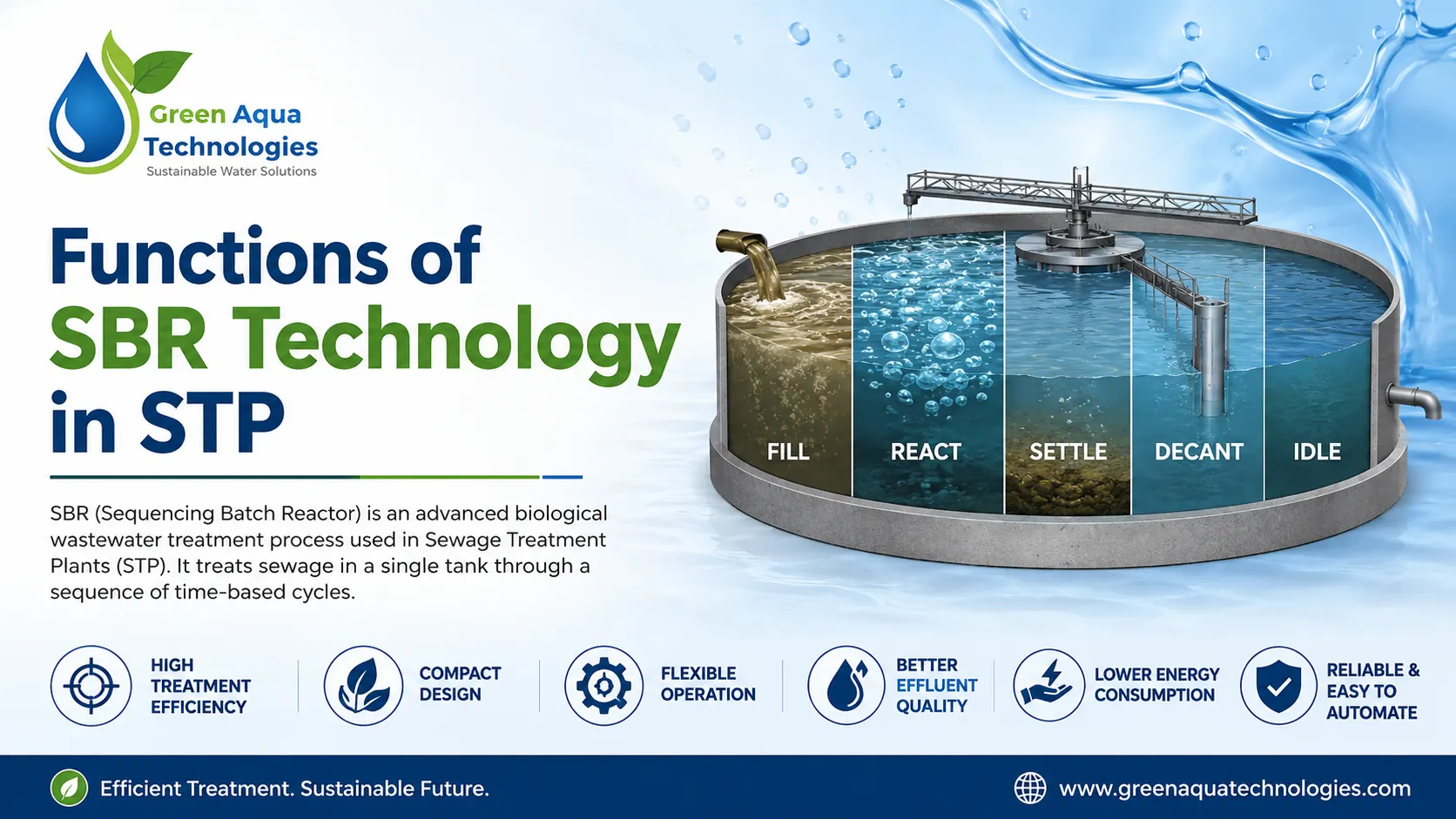
SBR (Sequencing Batch Reactor) technology is an advanced biological treatment process used in Sewage Treatment Plants (STPs) for treating domestic and municipal wastewater. SBR system performs biological treatment, settling and treated-water withdrawal in the same reactor through a controlled sequence of time-based cycles. A typical SBR cycle includes Fill, React, Settle, Decant and Idle phases.
For organizations looking for reliable wastewater treatment solutions, Green Aqua Technologies provides STP solutions designed around the specific flow, sewage characteristics, space availability and treated-water requirements of the project.
What is SBR Technology in STP?
SBR is essentially a fill-and-draw activated sludge process. Instead of continuously moving wastewater through separate aeration and clarification tanks, the same reactor carries out different treatment functions sequentially. During the biological reaction phase, microorganisms break down biodegradable organic matter and, depending on the operating conditions, biological nitrogen removal can also be achieved.
One of the important characteristics of SBR technology is its operational flexibility. Aeration, mixing and cycle duration can be adjusted according to wastewater characteristics and treatment objectives.
SBR Full Form and Meaning in STP
SBR stands for Sequencing Batch Reactor. In a Sewage Treatment Plant (STP), SBR is a biological wastewater treatment technology used to remove organic pollutants and suspended solids from sewage. Unlike conventional treatment systems that use separate tanks for different processes, an SBR performs several treatment stages in the same reactor tank in a specific sequence.
The typical SBR treatment cycle includes Fill, React, Settle, Decant, and Idle phases. During the React phase, microorganisms break down biodegradable organic matter with controlled aeration. After aeration stops, the biological sludge settles at the bottom of the reactor, allowing relatively clear treated water to be removed during the Decant phase.
Main Functions of SBR Technology in STP
1. Fill Phase
The Fill phase is the stage where incoming sewage enters the SBR reactor. The wastewater mixes with the activated biomass retained from the previous cycle. Depending on the treatment objective, filling can occur under static, mixed or aerated conditions.
This phase introduces the organic load into the reactor and prepares the wastewater for biological treatment.
2. React or Aeration Phase
During the React phase, controlled aeration and mixing support biological activity. Microorganisms consume biodegradable organic matter, helping reduce pollutants such as BOD. With suitable control of oxygen availability and mixing conditions, nitrification and denitrification can also be incorporated into the treatment cycle.
The aeration duration and intensity are important operating parameters because excessive or insufficient aeration can affect treatment performance and energy consumption.
3. Settling Phase
After biological treatment, aeration and mixing are stopped so that activated sludge can settle naturally at the bottom of the reactor. This creates a relatively clear supernatant above the settled biomass.
The settling phase effectively performs the solid-liquid separation that would otherwise require a separate clarifier in many conventional systems.
4. Decanting Phase
Once the sludge has settled, the clarified treated water is removed from the upper portion of the reactor through a decanter. The decanter is designed to withdraw the supernatant while minimizing disturbance to the settled sludge layer.
Proper decanting is essential because excessive sludge carryover can negatively affect the quality of the treated effluent.
5. Idle Phase
The Idle phase occurs between decanting and the next filling cycle. Depending on the plant design and operating strategy, excess sludge may be wasted during this period and the reactor is prepared for the next cycle.
The duration of the idle phase can be adjusted according to flow conditions and the overall operating schedule.
Functions of SBR Technology Beyond Basic Treatment
SBR technology is not limited to simple organic-load reduction. By changing aeration and mixing conditions during different parts of the cycle, the process can be configured for additional biological treatment objectives.
BOD Removal
Microorganisms use biodegradable organic matter as a food source during biological treatment, helping reduce the BOD concentration in sewage.
Nitrogen Removal
Controlled aerobic and anoxic conditions can support nitrification and denitrification, allowing nitrogen removal to be incorporated into the SBR cycle.
Solids Separation
The reactor provides a dedicated settling period where biological solids separate from the treated water.
Effluent Withdrawal
The decanter removes clarified water after settling without requiring a separate conventional secondary clarifier.
Process Flexibility
Cycle times, aeration and mixing conditions can be modified according to changes in hydraulic and organic loading. This flexibility is one reason SBR systems are used where wastewater flow or characteristics vary.
Advantages of SBR Technology in Sewage Treatment Plants
SBR technology can offer several practical benefits when properly designed and operated:
- Compact treatment arrangement
- Biological treatment and settling in one reactor
- No separate secondary clarifier in the SBR process
- Flexible cycle-based operation
- Potential for nitrogen removal
- Good handling of variable loading
- Automated operation can reduce manual intervention
- Controlled aeration can help optimize energy consumption
- Suitable for a range of sewage treatment applications
Because the same reactor performs multiple treatment functions, SBR can reduce the number of separate process units required compared with some conventional activated-sludge configurations.
Why Choose Green Aqua Technologies for SBR-Based STP?
Green Aqua Technologies focuses on wastewater treatment solutions designed according to project-specific requirements. An SBR-based STP can be considered where a compact, flexible and cycle-controlled biological treatment process is suitable.
The actual SBR cycle, reactor volume, aeration requirement, decanter arrangement and operating controls should be determined through proper engineering and wastewater characterization rather than applying one standard cycle to every project.
Conclusion:
SBR technology provides a flexible approach to sewage treatment by performing filling, biological reaction, settling, decanting and sludge management in a controlled sequence. Its ability to combine biological treatment and clarification functions within the reactor makes it an attractive option for projects where space, operational flexibility and treatment performance are important.
With proper process design, automation and operating control, SBR can support BOD removal, nitrification, denitrification and effective solid-liquid separation. For businesses and institutions evaluating an SBR-based Sewage Treatment Plant, Green Aqua Technologies can be considered for project-specific wastewater treatment solutions.