With rapid urbanization and industrial growth, wastewater management has become a critical environmental requirement. Treating sewage water before discharge or reuse is essential to protect water bodies and public health. Two commonly used terms in wastewater treatment are STP (Sewage Treatment Plant) and SBR (Sequencing Batch Reactor). Many people often get confused and ask, what is the difference between SBR and STP?
This blog explains the concepts of SBR and STP in detail, their working principles, full forms, and key differences to help you choose the right wastewater treatment solution.
What is STP (Sewage Treatment Plant)?
An STP, or Sewage Treatment Plant, is a complete system designed to treat domestic and industrial wastewater. The main purpose of an STP is to remove contaminants, organic matter, and harmful microorganisms from sewage so that the treated water can be safely discharged or reused.
STP Tank Full Form- The STP tank full form is Sewage Treatment Plant Tank. It refers to the tanks used in different stages of sewage treatment, such as collection, aeration, clarification, and sludge handling.
STPs generally consist of multiple units, including screening chambers, equalization tanks, aeration tanks, settling tanks, and disinfection units. Each stage performs a specific function in the wastewater treatment process.
How Does an STP Work?
The working of an STP follows a continuous flow process. Sewage water enters the plant and passes through several treatment stages. Initially, large solids are removed through screening. After that, biological treatment helps break down organic matter using microorganisms. Finally, the treated water is clarified and disinfected before discharge or reuse.
Traditional STPs are effective but usually require more space, multiple tanks, and higher operational supervision.
What is SBR (Sequencing Batch Reactor)?
SBR is an advanced biological wastewater treatment technology used within an STP system. Unlike conventional STPs, SBR treats wastewater in batches rather than continuous flow. This makes it highly efficient and compact.
SBR Full Form- The SBR full form is Sequencing Batch Reactor.
SBR Full Form in STP- The SBR full form in STP remains the same – Sequencing Batch Reactor. It refers to the biological treatment process used inside the sewage treatment plant.
SBR STP Full Form- The SBR STP full form is Sequencing Batch Reactor Sewage Treatment Plant, which indicates an STP that uses SBR technology for wastewater treatment.
How Does SBR Technology Work in STP?
In an SBR-based STP, all treatment stages occur in a single tank in a sequential manner. The process includes filling the tank with sewage, aeration for biological treatment, settling of sludge, decanting of treated water, and an idle phase before the next cycle begins.
Because the same tank performs multiple functions, SBR systems require less space and provide better control over treatment efficiency. This makes SBR technology ideal for modern wastewater treatment needs.
What is the Difference Between SBR and STP?
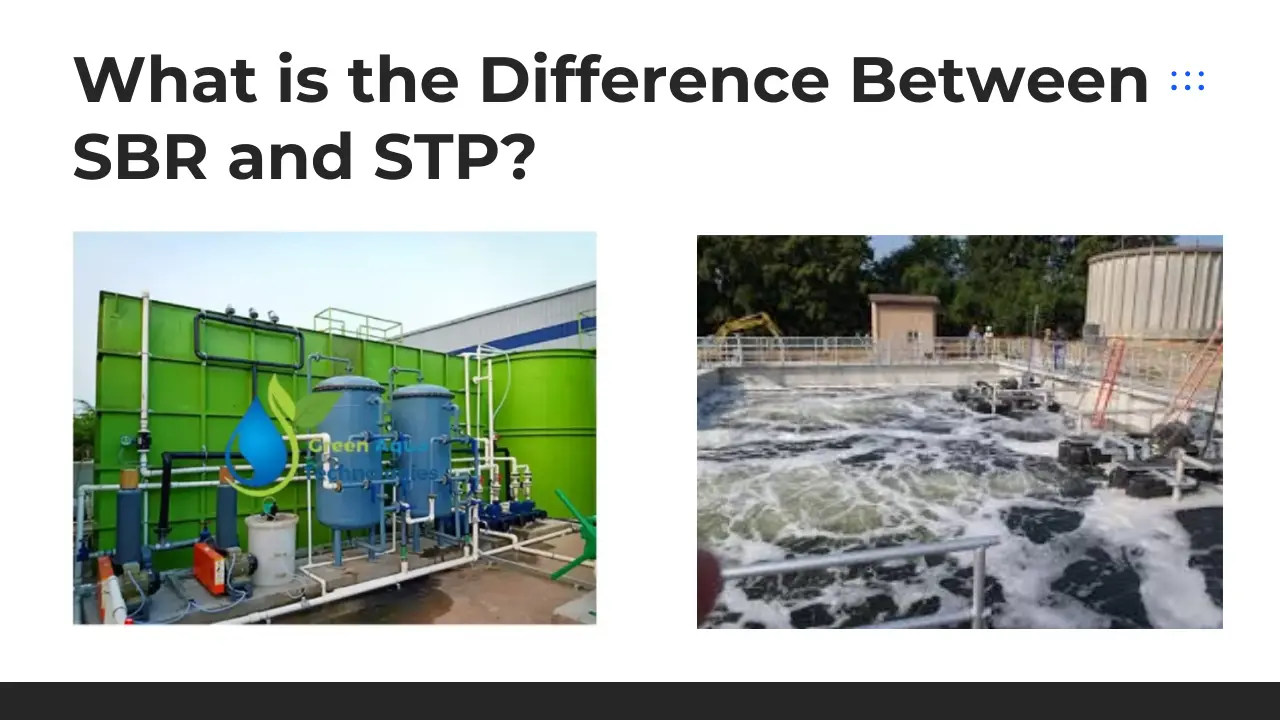
To clearly understand what is the difference between SBR and STP, it is important to know that STP is a complete treatment system, while SBR is a treatment process used within an STP.
An STP can operate using different technologies such as Activated Sludge Process (ASP), MBBR, or SBR. On the other hand, SBR is specifically a biological treatment method that improves the performance of the STP.
Key Differences Between SBR and STP Explained
The main difference lies in their structure and operation. A conventional STP uses multiple tanks and operates continuously, whereas an SBR-based STP uses fewer tanks and works in batches. SBR systems are more compact and easier to automate compared to traditional STPs.
Another major difference is efficiency. SBR technology offers better removal of BOD, COD, and suspended solids, resulting in higher quality treated water. This makes SBR-based systems more suitable for water reuse applications.
Advantages of SBR Over Conventional STP
SBR-based sewage treatment plants offer several advantages over conventional STPs. They require less land area, making them ideal for space-constrained locations. The batch process allows better control over treatment parameters, resulting in consistent performance even with fluctuating sewage loads.
Additionally, SBR systems consume less energy, generate less sludge, and require minimal operator intervention due to automation. These benefits make SBR technology a preferred choice for residential complexes, commercial buildings, hotels, hospitals, and industries.
When Should You Choose a Conventional STP?
A conventional STP may be suitable when land availability is not a concern and the sewage load is stable. Such systems are often used in small towns or areas where advanced automation is not required. Conventional STPs are also preferred when initial investment needs to be kept low.
However, operational efficiency and treated water quality may not be as high as that of an SBR-based system.
When is an SBR-Based STP the Best Choice?
An SBR-based STP is the best choice when high treatment efficiency, compact design, and water reuse are priorities. These systems are ideal for urban areas where space is limited and pollution control norms are strict.
If you require consistent treated water quality for gardening, flushing, or industrial reuse, SBR technology offers a reliable and sustainable solution.
Role of Green Aqua Technologies in SBR and STP Solutions
Green Aqua Technologies specializes in designing, manufacturing, and installing advanced sewage treatment solutions. The company offers customized SBR-based STP systems that meet regulatory standards and deliver long-term performance.
With a focus on sustainability and efficiency, Green Aqua Technologies ensures reliable wastewater treatment solutions for residential, commercial, and industrial applications.
Conclusion
In summary, if you are wondering what is the difference between SBR and STP, the answer is simple. An STP is a complete sewage treatment system, while SBR is an advanced biological treatment process used within an STP.
SBR-based STPs provide higher efficiency, compact design, and better treated water quality compared to conventional systems. Choosing the right solution depends on your project requirements, space availability, and reuse needs. For advanced and reliable wastewater treatment solutions, SBR technology is the future of sewage treatment.