Water is one of the most important resources in industrial operations, but untreated water often contains dissolved minerals, salts, and impurities that can damage equipment and reduce production efficiency. Industries such as pharmaceuticals, power generation, chemicals, food processing, textiles, and electronics require high-purity water to maintain product quality and protect machinery.
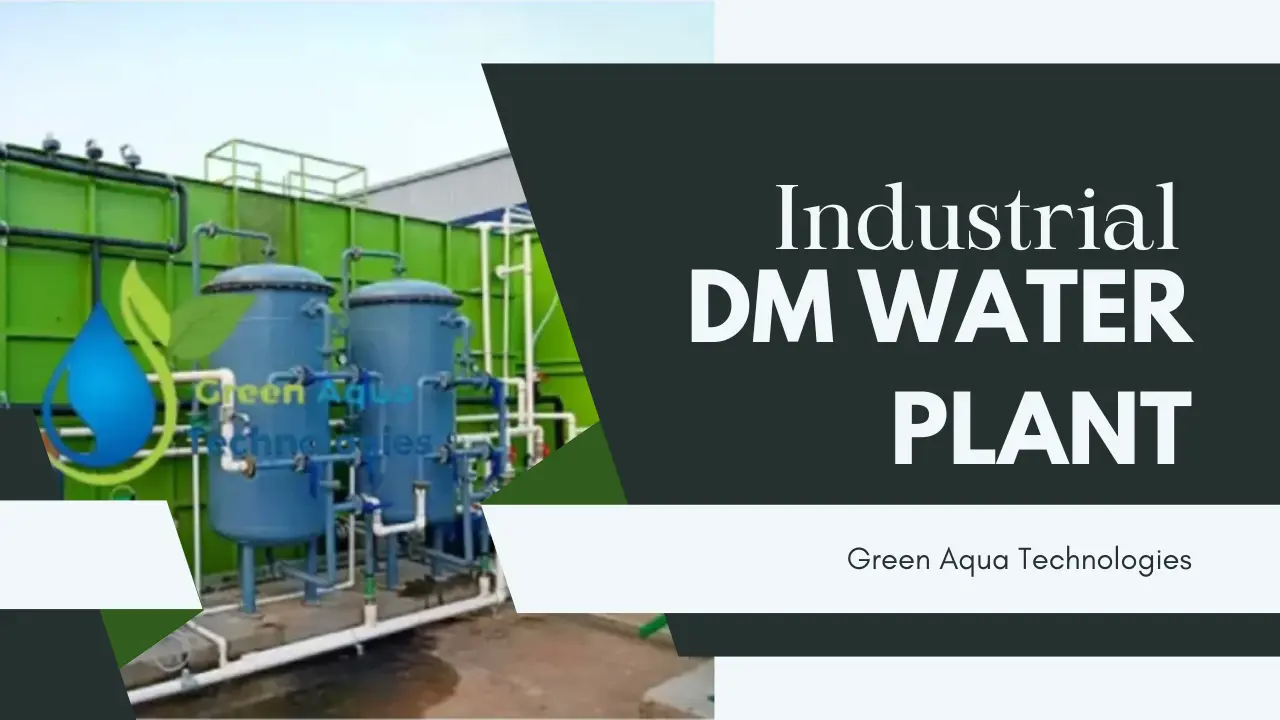
Demineralized (DM) Water Plant removes dissolved minerals and ionic impurities from raw water, producing high-quality water suitable for critical industrial applications. Green Aqua Technologies is a trusted manufacturer of Industrial DM Water Plants, offering customized water treatment solutions that deliver reliable performance, high efficiency, and long service life.
What is a DM Water Plant?
Full Form of DM Plant: Demineralized Water Tank
DM Water Plant is a water treatment system designed to remove dissolved salts, minerals, and ions from raw water through the ion exchange process. The treated water has very low conductivity and high purity, making it suitable for industries where mineral-free water is essential.
Unlike ordinary filtration systems, a DM Water Plant removes both positively and negatively charged ions, ensuring consistent water quality for industrial processes.
Working Principle of an Industrial DM Water Plant
The working principle of a DM Water Plant is based on ion exchange technology. Water passes through specially designed resin beds that replace dissolved ions with hydrogen (H⁺) and hydroxyl (OH⁻) ions. These ions combine to form pure water (H₂O), resulting in demineralized water with minimal dissolved solids.
The system continuously monitors water quality to ensure the required purity level is maintained for industrial applications.
Cation Exchange Unit: The raw water first passes through the cation resin, which removes positively charged ions such as calcium (Ca²⁺), magnesium (Mg²⁺), sodium (Na⁺), and iron (Fe²⁺). These ions are replaced with hydrogen (H⁺) ions.
Anion Exchange Unit: The water then enters the anion resin, where negatively charged ions such as chloride (Cl⁻), sulfate (SO₄²⁻), nitrate (NO₃⁻), bicarbonate (HCO₃⁻), and silica are removed and replaced with hydroxyl (OH⁻) ions.
Mixed Bed Unit (Optional): For applications requiring ultra-pure water, the treated water passes through a Mixed Bed Unit containing a mixture of cation and anion resins. This polishing stage removes the remaining traces of dissolved ions, ensuring maximum water purity and extremely low conductivity.
Industrial DM Water Plant Process
1. Raw Water Collection
Raw water from borewells, rivers, or municipal supplies is collected in a storage tank before treatment.
2. Pre-Treatment
The water passes through sand filters, activated carbon filters, and cartridge filters to remove suspended solids, chlorine, and organic impurities.
3. Cation Exchange Unit
Water enters the cation resin vessel, where calcium, magnesium, sodium, and other positively charged ions are exchanged with hydrogen ions.
4. Degassing (Optional)
Carbon dioxide formed during the cation exchange process is removed using a degasser tower to improve water quality.
5. Anion Exchange Unit
The water then flows through the anion resin vessel, which removes chloride, sulfate, nitrate, silica, and other negatively charged ions by replacing them with hydroxyl ions.
6. Mixed Bed Polisher
For applications requiring ultra-pure water, a mixed bed unit provides final polishing and significantly reduces water conductivity.
7. DM Water Storage
The purified water is stored in a dedicated storage tank before being supplied to industrial processes.
Mix Bed DM Plant Design
Mix Bed DM Plant is designed to produce high-purity demineralized water by using a single vessel filled with a carefully balanced mixture of cation and anion exchange resins. This design acts as a polishing unit, removing the remaining dissolved ions after primary water treatment and delivering water with extremely low conductivity. Mix Bed DM Plants are widely used in industries where ultra-pure water is essential, such as pharmaceuticals, power plants, electronics, laboratories, chemicals, and food processing.
The design of a Mix Bed DM Plant includes a pressure vessel, mixed bed resin, internal distribution and collection systems, regeneration arrangement, control valves, piping, instrumentation, and a control panel. During operation, water flows uniformly through the mixed resin bed, where both positive and negative ions are simultaneously exchanged for hydrogen (H⁺) and hydroxyl (OH⁻) ions. These ions combine to form pure water (H₂O), ensuring excellent water quality.
Advantages of an Industrial DM Water Plant
- Produces high-purity demineralized water
- Prevents scale formation in boilers and pipelines
- Improves equipment efficiency and lifespan
- Reduces maintenance and operating costs
- Ensures consistent product quality
- Removes dissolved salts and minerals effectively
- Environment-friendly water treatment solution
- Suitable for continuous industrial operation
- Customizable for different industrial capacities
Why Choose Green Aqua Technologies?
Green Aqua Technologies is a leading manufacturer of Industrial DM Water Plants, delivering advanced water treatment systems for industries across India. The company designs customized DM Water Plants using high-quality components, advanced ion exchange technology, and efficient automation to ensure reliable and consistent performance.
With a strong focus on quality, innovation, and customer satisfaction, Green Aqua Technologies provides complete solutions, including design, manufacturing, installation, commissioning, and after-sales support. Every Water Treatment Plant is engineered to maximize water purity, reduce operational costs, and meet the specific requirements of each industry.
Conclusion
Understanding what is dm plant and how it works is essential for industries aiming to achieve high-quality water standards. From the dm plant process to the dm plant regeneration process, every stage plays a crucial role in delivering pure and reliable water. With wide-ranging dm water uses, investing in a well-designed dm plant is not just a necessity but a smart decision for long-term industrial success. If you are looking for efficient and durable water treatment solutions, Green Aqua Technologies is your trusted partner.